

Best No-Code Website Builders for Small Businesses (2026)
9 min
read
The best no-code website builders for small businesses in 2026. Honest comparison of Wix, Squarespace, Webflow, Framer, Hostinger, Durable, Kite, and Shopify with real pricing.


Most small business owners pick a no-code website builder by googling "best website builder" and clicking the first sponsored result. Six months later they are locked into a platform that does not fit their business, paying renewal rates two to three times the intro price.
This guide covers eight platforms with honest trade-offs, real 2026 pricing, and a clear verdict on who each one is actually built for.
Key Takeaways
- Wix Harmony is the best all-around pick for most small businesses. Largest template library, strongest AI tools, free plan available.
- Squarespace wins on design quality. Best choice for service businesses, creatives, and local brands that lead with visual identity.
- Webflow is not for beginners. It is a professional visual development tool that rewards design and technical experience.
- Framer is the fastest-growing Webflow alternative. Simpler pricing, comparable design output, no native ecommerce.
- Hostinger Horizons is the best budget pick. AI-generated sites in minutes, all-in bundled pricing from $2.99/month.
- Durable is the fastest way to get online. AI builds a full site from a business description in under 30 seconds.
- Kite skips templates entirely. A conversational AI interview builds three custom site options, then handles edits and maintenance via chat.
- Shopify is the only right choice if ecommerce is your primary business model. Everything else is a compromise.
- Renewal pricing matters more than intro pricing. Several platforms on this list cost 2 to 3x more after year one.
What Makes a No-Code Website Builder Worth Using in 2026
Not every drag-and-drop tool deserves the "no-code" label. The platforms worth your attention in 2026 share four qualities.
First, AI-assisted setup. Every serious builder now offers some form of AI site generation. The best ones produce a usable starting point from a short business description and reduce setup time from days to hours.
Second, bundled hosting and security. A good no-code builder includes SSL, CDN, automatic backups, and uptime monitoring in the plan price. Paying separately for these adds cost and complexity that defeats the purpose.
Third, real ecommerce or a clear path to it. If you sell products or plan to, the builder needs native checkout support. Workarounds using third-party tools create friction for customers and complexity for you.
Fourth, honest total cost of ownership. The advertised monthly price is rarely what you pay once you add a custom domain, business email, and the apps or features your actual site needs. The platforms below show real-world pricing, not just the entry headline.
Wix Harmony: Best All-Around No-Code Builder
Wix Harmony is the 2026 release of Wix's core platform, now with AI generation, AI image tools, and an updated drag-and-drop editor baked into one experience.
It covers more use cases from one platform than any other builder on this list: service sites, ecommerce stores, blogs, booking pages, membership areas, and portfolios.
Who Wix Harmony Is Built For
Wix works best for:
- Local service businesses that need contact forms, booking, and a Google-friendly presence
- Small retailers adding ecommerce to an existing brand
- Creators and bloggers who want design flexibility without a learning curve
- First-time website owners who want AI to handle the first draft
Wix Harmony Pricing (2026)
| Plan | Monthly Price (annual billing) | Best For |
|---|---|---|
| Free | $0 | Testing only. Wix subdomain, ads on page. |
| Light | $17/month | Personal or single-page sites |
| Core | $29/month | Most small business sites |
| Business | $36/month | Ecommerce, subscriptions, bookings |
| Business Elite | $159/month | High-volume stores |
800+ templates available, more than any other builder on this list. All are mobile-responsive.
Wix Harmony Strengths
- Largest app marketplace of any no-code builder. Booking, CRM, live chat, email marketing, and hundreds more are one-click installs.
- Wix ADI generates a full site from a short description of your business. Useful starting point, fully editable after generation.
- Free plan lets you test the full editor before spending anything. Most competitors do not offer this.
Wix Harmony Limitations
- You cannot switch templates after publishing without rebuilding the site from scratch. Choose carefully at the start.
- Wix Studio, the agency-focused version, uses a separate interface and pricing structure. Do not confuse the two.
- Base44, an internal tool builder acquired by Wix in 2025, is now part of the ecosystem but serves a different use case entirely.
Squarespace: Best No-Code Builder for Design-Led Businesses
Squarespace is the best-looking platform on this list. Its templates are consistently polished, and the Blueprint AI system helps you assemble a layout without a design background.
It is the right choice when how your site looks is directly tied to how your business is perceived: restaurants, photographers, consultants, boutiques, and local service brands.
Who Squarespace Is Built For
Squarespace works best for:
- Service businesses where first impressions determine whether someone calls
- Photographers, designers, and creatives building portfolio sites
- Restaurants, cafes, and local brands with a strong visual identity
- Small businesses that want a polished site without ongoing maintenance
Squarespace Pricing (2026)
| Plan | Monthly Price (annual billing) | What Is Included |
|---|---|---|
| Basic | $16/month | Hosting, SSL, templates, analytics |
| Core | $23/month | Ecommerce up to 2% transaction fee |
| Plus | $39/month | Advanced ecommerce, no transaction fees |
| Advanced | $99/month | Abandoned cart recovery, subscriptions |
180+ award-winning templates, widely regarded as the best-looking in the industry. All include hosting, SSL, and analytics.
Squarespace Strengths
- Blueprint AI walks you through layout selection in a guided flow. You make the choices, it assembles the structure.
- Multi-author blogging and podcast hosting built in. Useful for content-driven small businesses.
- 24/7 uptime monitoring and reliable hosting included on every plan.
Squarespace Limitations
- Design flexibility has a ceiling. The fluid editor keeps you working within the template structure. You cannot freely place elements anywhere on the canvas like you can in Wix.
- No free plan. A 14-day trial is available, but you pay before publishing.
- Ecommerce transaction fees apply on the Basic and Core plans. Add those to the headline price when comparing.
Webflow: Best No-Code Builder for Design Professionals
Webflow is not a typical no-code builder. It is a visual development tool that generates clean, production-ready HTML and CSS. You build with flexbox, grid, and CSS classes in a visual interface.
That description should already tell you whether it is right for your situation.
Who Webflow Is Built For
Webflow works best for:
- Designers and agencies building sites for clients
- Product teams creating landing pages with custom interactions
- Small businesses that want full design control and are willing to spend time learning the tool
- Companies that need a real CMS for blog or content management
Webflow Pricing (2026)
| Plan | Monthly Price (annual billing) | Notes |
|---|---|---|
| Basic | $15/month | Static sites only, no CMS |
| Premium | $29/month | CMS, 50GB bandwidth, AI credits |
| Advanced | $99/month | Higher bandwidth, white-label |
| Ecommerce (add-on) | $29 to $212/month | On top of site plan cost |
Warning on Webflow pricing: After a major restructure in May 2026, Premium's included bandwidth dropped to 50GB and Team plan pricing was added at $2,500/month. Agency-managed CMS sites with full seats and locale add-ons can reach $1,476/year for a single site. Read the full plan details before committing.
Webflow Strengths
- Clean semantic HTML output. The code Webflow generates is production-quality, not the bloated markup typical of drag-and-drop builders.
- Powerful CMS. Dynamic content, collections, and referencing work properly. Better than anything Wix or Squarespace offers for content-heavy sites.
- Custom interactions and animations without writing JavaScript.
Webflow Limitations
- Steep learning curve. Non-designers and non-developers will struggle. This is not a beginner tool.
- Pricing complexity. Site plans, Workspace plans, seat costs, bandwidth overages, locale add-ons. Calculate your true annual cost before signing up.
- You cannot export your site as working code and host it elsewhere. Leaving Webflow means starting over.
Framer: Best No-Code Builder for Fast, Design-Forward Sites
Framer started as a prototyping tool for product designers. In 2026 it is one of the fastest-growing website builders in the market, driven primarily by Webflow users who found the pricing restructure too expensive to justify.
It delivers comparable design output to Webflow at significantly simpler pricing.
Who Framer Is Built For
Framer works best for:
- Designers and founders building portfolio or SaaS marketing sites
- Small businesses that want a design-forward site without Webflow's complexity
- Teams migrating away from Webflow seeking comparable output at lower cost
- Product and agency sites that prioritize visual impact over ecommerce
Framer Pricing (2026)
| Plan | Monthly Price (annual billing) | Notes |
|---|---|---|
| Free | $0 | Framer subdomain, limited pages |
| Mini | $5/month | Custom domain, 1 page |
| Basic | $15/month | Unlimited pages, CMS |
| Pro | $30/month | More CMS items, custom code |
$10 to $30/month per site versus Webflow's stacked pricing that can exceed $1,400/year for one agency-managed CMS site. This is why Framer is the top-named destination in Webflow migration discussions.
Framer Strengths
- Live collaboration built into the editor. Multiple designers can work simultaneously.
- Fast visual output. Sites built in Framer load quickly and look polished with significantly less effort than Webflow requires.
- Simple, per-site pricing. No workspace plans, no seat costs, no per-locale add-ons.
Framer Limitations
- No native ecommerce. You can integrate Stripe checkout or Gumroad, but Framer is not an ecommerce platform. Do not use it as your primary store.
- CMS is functional but less powerful than Webflow's for complex content structures.
- Relatively new ecosystem. Fewer third-party integrations than Wix or Squarespace.
Hostinger Horizons: Best Budget No-Code Builder
Hostinger Horizons is the AI-first no-code builder from Hostinger, bundled with their hosting service. It generates a usable, fully hosted website from a business description and a few prompts in minutes.
For small businesses that need to get online quickly at the lowest possible cost, it is the most practical option on this list.
Who Hostinger Horizons Is Built For
Hostinger works best for:
- Budget-conscious small businesses or sole traders getting online for the first time
- Local businesses that need a functional site fast without design decisions
- Anyone testing a business idea before investing in a more capable platform
- Small teams that want domain, hosting, and site creation managed from one login
Hostinger Pricing (2026)
| Plan | Price | Notes |
|---|---|---|
| Year one (intro) | From $2.99/month | Domain, hosting, and builder bundled |
| Renewal | From $8.99/month | Roughly 3x the intro rate |
Watch the renewal rate. Hostinger's intro pricing is genuinely low. The year-two rate is roughly three times higher. Budget for renewal pricing, not intro pricing, when comparing total cost of ownership.
Hostinger Strengths
- AI site generation is fast. Enter your business name and description, and Horizons produces a multi-page site with placeholder copy and a working layout in under two minutes.
- Bundled domain, hosting, and business email in one plan. No separate accounts to manage.
- LiteSpeed servers with global CDN for reliable performance. Better load speed than most entry-tier builders.
Hostinger Limitations
- Template switching means starting over. Once you choose a layout, major redesigns require rebuilding.
- Limited advanced customization. Fine for a five-page service site. Not the right choice if you need complex functionality or a powerful CMS.
- Renewal pricing jump. The gap between intro and renewal pricing is the largest on this list.
Durable: Fastest No-Code Builder for Getting Online
Durable is an AI-first website builder designed around one promise: a complete small business website in under 30 seconds.
It is not the most customizable platform here. It is the fastest way to go from a business idea to a live website with a domain, CRM, invoicing, and basic marketing tools included.
Who Durable Is Built For
Durable works best for:
- Solopreneurs and service providers who need a professional web presence immediately
- Local businesses, tradespeople, and consultants who want everything in one place
- Small teams replacing a cobbled-together stack of separate tools
- Anyone running a client discovery or sales call who needs to show a live site the same day
Durable Pricing (2026)
| Plan | Monthly Price | What Is Included |
|---|---|---|
| Starter | $15/month | AI site builder, custom domain |
| Business | $25/month | CRM, invoicing, marketing tools |
Durable Strengths
- 30-second site generation. Enter your business type and location. Durable builds a full homepage, about page, services page, and contact form instantly.
- CRM, invoicing, and marketing tools are built into the platform. This is the unique value proposition: one subscription replaces several tools.
- Designed for non-technical owners. The editing interface requires no design decisions. You swap text and images, not layouts or spacing.
Durable Limitations
- Limited design control. If you care about custom fonts, precise layout, or branded visual systems, Durable is frustrating.
- Not suitable for ecommerce. It handles service businesses and appointment bookings, not product stores.
- Small template variety. The AI generator produces good starting points, but the range is narrower than Wix or Squarespace.
Kite: Best Conversational AI Website Builder
Kite takes a different approach from every other platform on this list. Instead of handing you a template to customize, it interviews you about your business through a short conversation and builds three custom design options from your answers.
There is no template library to browse. No drag-and-drop grid to learn. The AI handles design, copy, and code while you answer questions about what you do and who you serve.
Who Kite Is Built For
Kite works best for:
- Founders and freelancers who want a professional site fast without template decisions
- Creators and small business owners who find traditional builders overwhelming
- LinkedIn-heavy professionals who want to turn their profile into a website in one click
- Anyone who wants ongoing site maintenance handled by AI agents after launch
Kite Pricing (2026)
| Plan | Monthly Price | What Is Included |
|---|---|---|
| Free | $0 | Limited credits, Kite subdomain |
| Creator | $29/month (launch offer, normally $39) | Custom domain, hosting, unlimited edits |
| Business | Custom pricing | Advanced features, priority support |
Credit-based usage applies. Factor this into your monthly cost estimate if you plan heavy post-launch editing or use the maintenance agents frequently.
Kite Strengths
- Conversational build process. No template browsing, no layout decisions. Answer questions, review three custom options, pick one. The design comes to you.
- Chat-based editing after launch. Instead of learning an editor interface, you tell Kite what to change and it makes the change.
- LinkedIn-to-website in one click. Pulls your professional profile into a site structure instantly. Useful for consultants and service providers.
- Post-launch maintenance agents. AI handles ongoing updates, SEO checks, and content suggestions after the site goes live.
- Automatic SEO and hosting included on all paid plans.
Kite Limitations
- Smaller integration library than established platforms. Some third-party integrations are still rolling out. If you need specific tools connected on day one, check current availability before committing.
- Credit-based usage model adds a variable cost layer that flat-rate builders do not have. Review the credit consumption for your intended use before choosing a plan.
- Newer platform. Less community support, fewer tutorials, and a shorter track record than Wix or Squarespace. A reasonable trade-off if the conversational build approach fits how you work.
Shopify: Best No-Code Builder for Ecommerce
If your business sells physical or digital products online, Shopify is not one option among many. It is the correct choice.
Every other platform on this list either treats ecommerce as an add-on or does not support it at all. Shopify is built from the ground up for selling, and it shows in every part of the product.
Who Shopify Is Built For
Shopify works best for:
- Small businesses where online sales are the primary revenue model
- Physical product brands adding a direct-to-consumer channel
- Businesses managing inventory, shipping, and fulfillment alongside a website
- Stores that want to unify online and in-person sales through Shopify POS
Shopify Pricing (2026)
| Plan | Monthly Price (annual billing) | Transaction Fee |
|---|---|---|
| Basic | $29/month | 2% (third-party payments) |
| Shopify | $79/month | 1% |
| Advanced | $299/month | 0.5% |
Transaction fees add up fast. On the Basic plan, every $1,000 in sales costs $20 in platform fees on top of your payment processor fee. Move to the Shopify plan once monthly revenue makes the upgrade math work in your favor.
Shopify Strengths
- Purpose-built for ecommerce. Inventory management, shipping integrations, discount codes, abandoned cart recovery, and product variants all work out of the box.
- Shopify POS unifies in-store and online sales in one system. No third-party integration required.
- Massive app ecosystem. Thousands of integrations for every ecommerce need.
Shopify Limitations
- Not a great content or branding site. Shopify's page builder is functional but less flexible than Webflow or Framer for marketing pages.
- Transaction fees on Basic and Shopify plans unless you use Shopify Payments, which is not available in all countries.
- Monthly cost adds up quickly once you add apps that replicate features other platforms bundle for free.
No-Code Website Builder Comparison: Full Overview
| Builder | Best For | Starting Price | Free Plan | Ecommerce | AI Builder |
|---|---|---|---|---|---|
| Wix Harmony | All-around small business | $17/month | Yes | Yes | Yes |
| Squarespace | Design-led service businesses | $16/month | No (14-day trial) | Yes | Yes (Blueprint AI) |
| Webflow | Design professionals, agencies | $15/month | No | Add-on ($29+) | Yes |
| Framer | Design-forward marketing sites | $5/month | Yes | No (third-party) | Yes |
| Hostinger Horizons | Budget first-timers | $2.99/month (intro) | No | Limited | Yes |
| Durable | Fastest go-live, service businesses | $15/month | No | No | Yes |
| Kite | Conversational AI build, no templates | $29/month (launch offer) | Yes | No | Yes (conversational) |
| Shopify | Product-based ecommerce | $29/month | No (3-day trial) | Native | Limited |
How to Choose the Right No-Code Builder for Your Business
The right builder depends on four things: what you sell, how much design control you need, your real two-year budget, and how painful a future migration would be.
- Sell products? Start and end with Shopify. Every other platform treats ecommerce as a feature rather than the core product.
- Design-led service business? Squarespace or Framer. Both prioritize visual quality over feature volume.
- Need maximum flexibility? Wix covers the most use cases from one platform and scales further than any template builder here.
- Tight budget, fast launch? Hostinger Horizons for the lowest year-one cost. Durable if you want CRM and invoicing bundled in.
- Hate picking templates? Kite. Answer a short interview, get three custom designs, edit everything via chat.
- Professional design control? Webflow if you have the experience. Framer if you want comparable output at simpler pricing.
One thing every small business owner gets wrong: modeling intro pricing instead of renewal pricing. Hostinger jumps from $2.99 to $8.99 after year one. Webflow's Premium plan cut included bandwidth in May 2026 and stacked seat costs on top. Always price out year two before you commit.
When a No-Code Builder Is Not the Right Answer
No-code builders are the right tool for most small business websites. But there are three situations where they are the wrong starting point.
- You need a custom web application. User authentication, client portals, complex databases, or multi-role permissions are not website features. They are application features. No-code builders were not designed for this use case.
- Your business has outgrown templates. When your conversion requirements, integrations, or content architecture exceed what a builder supports, a custom build becomes more cost-effective than piling on workarounds.
- You want to own the underlying code. Every platform on this list hosts your site on their infrastructure. If pricing changes, features disappear, or the company pivots, you have limited recourse. A custom-coded site is the only way to fully own your digital foundation.
If any of these apply to your situation, the right move is a conversation with a development partner rather than another platform trial.


Work With LOW/CODE Agency on Your Website
Building a no-code site yourself gets you online. It does not always get you results.
LOW/CODE Agency specializes in building websites and digital experiences on no-code and low-code platforms for small and growing businesses. We know which platform fits which business, which integrations actually work in production, and how to build a site that converts visitors rather than just existing on the internet.
If you have outgrown what a template can do, or you want your website built right the first time without spending weeks learning a new tool, we can help.
Get in touch and we will scope your project in one conversation.
Looking to go no-code? Our no-code development services cover tools, builds and strategy.
Last updated on
September 28, 2026
.

Jesus is a visionary entrepreneur and tech expert. After nearly a decade working in web development, he founded LOW/CODE Agency to help businesses optimize their operations through custom software solutions.


FAQs
Which no-code website builder is best?
Can I build a website without coding?
What is a no-code website?
What is the disadvantage of no-code?
Related Articles
No-code/Low-code
Top Web Development Agencies
Find the top web development agencies in 2026. Compare leading firms by expertise, pricing, and client results to choose the right partner for your website.
No-code/Low-code
How to Hire the Best Web App Developers
Learn how to hire the best web app developers for your project. Compare skills, pricing, and platforms to find the perfect fit faster
No-code/Low-code
How to Work With No-code Agency
Work with a no-code agency the right way. Learn how to choose, collaborate, avoid mistakes, and build scalable products without wasting time or money.
No-code/Low-code
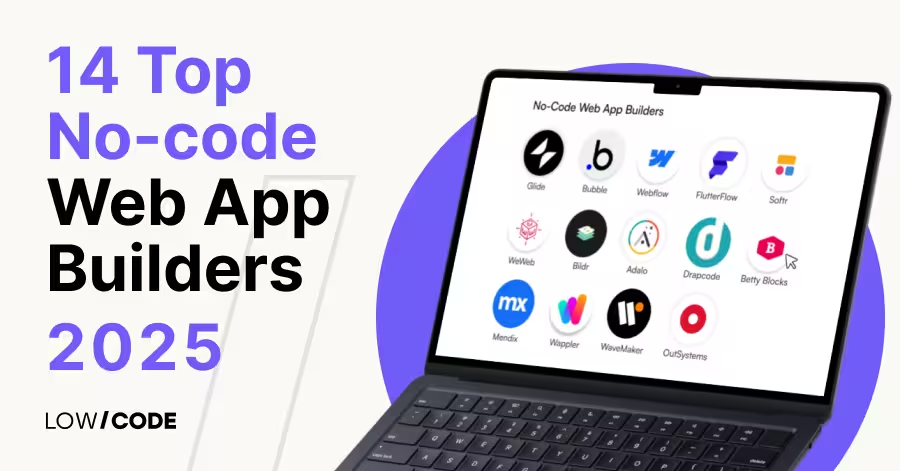
Top no-code web app builders for 2026
Discover the ultimate curated list of top no-code web app builders, empowering you to build web apps without coding.
Why customers trust us for no-code development


