

How to Translate a Glide App to Any Language (Complete Guide)
16 min
read
Learn how to translate a Glide app into any language using tables, computed columns, AI, and best practices for multi-language app setup and scaling.

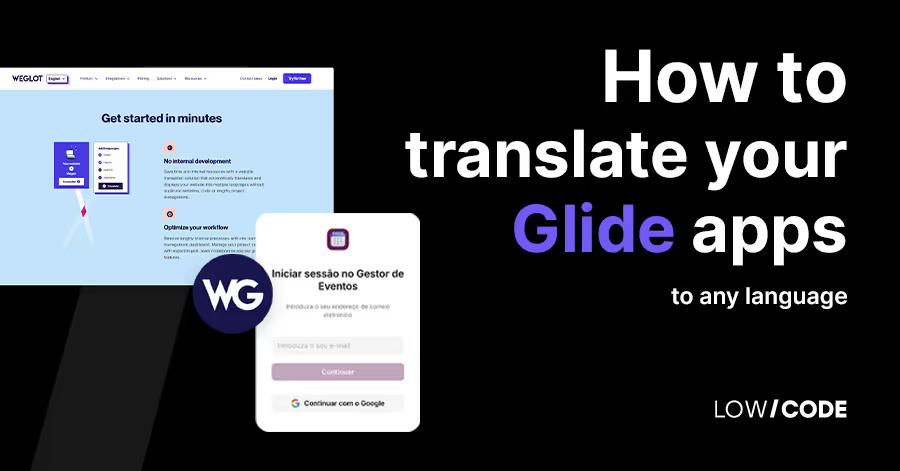
Translating a Glide app is entirely possible, but it requires a different approach than most platforms. Glide does not have a built-in language switcher or native localization system, which means you need to architect multi-language support yourself.
This guide explains every method, when to use each one, and how to build it correctly from the start.
Before committing to this architecture, it helps to understand the broader Glide advantages and disadvantages so you know where manual configuration is expected.
First — Can Glide Apps Actually Support Multiple Languages?
Glide apps can support multiple languages, but not through a native translation system. Some UI elements respond to device locale automatically, but custom labels, tab names, component text, and database content require manual architecture or third-party tools to translate.
- What changes automatically: Glide's system-generated UI elements (date formats, number formats, some navigation labels) may adapt based on the user's device or browser locale setting
- What does NOT translate natively: custom tab labels, button text, form field labels, screen titles, list captions, and any text you have typed directly into the Glide editor stays in its original language regardless of the user's locale
- No built-in language switcher: Glide does not include a language toggle or dynamic locale selector that changes the app's UI language on demand
- Database content does not auto-translate: product names, descriptions, and any text stored in your Glide Tables or Google Sheets are displayed exactly as stored, with no automatic translation layer
- What this means for your project: multi-language support in Glide is an architectural decision you make and build deliberately, not a setting you enable. This is consistent with how most serious Glide use cases require thoughtful data modeling rather than toggling features on.
Understanding this upfront prevents the most common mistake: building an entire app and then discovering that translation requires restructuring the whole data model.
Step 1 — Decide What "Translation" Means for Your App
Before building anything, define the exact scope of translation your app requires. The architecture for translating static UI labels is completely different from translating dynamic database content, and both are different from serving SEO multi-language pages.
Define which of these your project actually needs:
- Static UI labels only: tab names, button text, screen titles, and form labels. This is the simplest scope and manageable with visibility rules or a translations table
- Dynamic database content: product names, descriptions, categories, and any content stored as rows in your tables. This requires either separate columns per language or separate rows per language per record
- Multi-language per user: each user sees the app in their preferred language, selected at login or in their profile. This requires a language field in your Users table driving lookup logic across all displayed content
- Automatic browser-based switching: the app detects the user's browser language and displays the appropriate translation automatically, without any user action
- SEO multi-language: serving different language versions at different URLs or subdomains for search engine indexing. This requires a custom domain and a tool like Weglot
Most internal business apps need Option 1 (static labels) plus Option 3 (per-user preference). Most consumer-facing or content apps need dynamic content translation. Define your scope before you open the editor.
Your Three Real Options for Translating a Glide App
Option 1 — Manual Translation Using Tables (Most Flexible)
Build a Translations table that stores every UI string in every supported language, then use computed columns and lookup logic to display the correct string based on the user's language preference.
This is the most flexible and scalable approach for serious multi-language apps.
- Create a language field in your Users table: add a Language column (text or choice) where each user's preferred language is stored. This becomes the key that drives all translation lookups throughout the app
- Build a master Translations table: create a table with columns for String Key (a unique identifier like "btn_submit" or "label_product_name"), and one column per supported language (English, French, Spanish, etc.)
- Store text strings per language: each row in the Translations table is one UI string, with its translation in every language column. "btn_submit" might have "Submit" in English, "Envoyer" in French, and "Enviar" in Spanish
- Use Lookup or If-Then logic to display the correct language: in each screen component, instead of typing text directly, reference a computed column that looks up the correct translation based on the current user's Language field
- Use computed columns to dynamically return correct text: an If-Then column checks the user's language value and returns the matching column from the Translations table. This single pattern, repeated across your app, drives the entire translation system
If you want to see structured builds using similar relational logic, review real Glide app examples that rely heavily on computed columns and relations.
Option 2 — Duplicate Screens or Tabs Per Language
Create separate tabs or screens for each language and use visibility rules to show only the tab matching the user's language.
Simpler to build than the translations table approach, but significantly harder to maintain as content grows.
- Create separate tabs per language: build a complete version of each screen for each language and set visibility rules so only the correct language version is visible to each user
- Use visibility rules to show correct tab: each tab or screen has a visibility condition checking the user's Language field. Spanish users see the Spanish tabs, French users see French tabs
- Use icons instead of text labels: since tab labels in Glide cannot change dynamically, use icons for navigation to avoid showing the wrong language label at the navigation level
- When this method is practical: for apps with two languages, a small number of screens, and infrequent content changes. The build is faster but maintenance becomes painful quickly
- Maintenance drawbacks: every content update must be made in every language version separately. A five-screen app in three languages means fifteen screens to maintain. Any structural change multiplies in effort
At that stage, evaluating long-term Glide scalability becomes important before your architecture becomes difficult to refactor.
Option 3 — Automatic Translation with Third-Party Tools (Weglot)
Weglot and similar tools can automatically translate Glide app content by intercepting page rendering at the DNS level, translating text, and serving it from language-specific subdomains.
This approach requires a custom domain and has specific limitations with Glide's authentication.
- Requires a custom domain: Weglot works at the DNS level, meaning your app must be on a custom domain (app.yourbusiness.com) rather than a Glide subdomain
- Uses translated subdomains: Weglot creates subdomains like fr.app.yourbusiness.com and es.app.yourbusiness.com for each language, serving translated versions from those addresses
- DNS setup required: you point your domain's DNS to Weglot's servers, which proxy requests, translate content, and serve the result. This requires access to your domain's DNS settings
- Automatic translation pros: all visible text is translated automatically without building a translations table or writing any lookup logic. Updates to source content are re-translated automatically
- Limitations: Glide's login and authentication flows can behave unexpectedly when served through a translation proxy. CORS issues may arise with certain Glide features. The in-app language switcher Weglot provides may conflict with Glide's navigation structure
- When this makes sense: read-only or content-heavy apps, marketing-oriented tools, fast MVPs, and apps where you need translations quickly without a full translation architecture build
Because Glide apps run as browser-based deployments, you should understand how Glide PWA infrastructure works before implementing DNS-level translation proxies.
Step 2 — How to Build Manual Multi-Language Support Step by Step
Building manual multi-language support requires seven structured steps: adding a language selector to user profiles, creating a translations table, connecting translations to components, and adding fallback logic for missing strings.
Step 1: Add a language selector field to the Users table
Add a Language column to your Users table as a choice field with your supported language codes (EN, FR, ES, DE, etc.).
Add a language selector component to the user profile screen so users can set their preference. Set a default value (EN or the app's primary language) to ensure all users have a valid language value.
Step 2: Create a Translations table
Create a new table called Translations. Add a String Key column for unique identifiers and one column for each supported language. Populate it with every text string your app displays: button labels, screen titles, form field labels, empty state messages, and navigation labels.
Step 3: Structure columns per language
Keep your structure simple and explicit. Each row is one string, each language column holds that string's translation.
For example: String Key = "nav_products", English = "Products", French = "Produits", Spanish = "Productos".
Avoid JSON-based structures unless you have a specific technical reason, as they add parsing complexity without meaningful benefit at small to medium language counts.
Step 4: Link translations to UI components
For each component that displays text, instead of entering text directly, reference a computed column that returns the translated string.
Create a relation from a screen's data source to the Translations table matching on String Key, then use a lookup column to retrieve the correct language column based on the user's Language field.
Step 5: Use Lookup to fetch the correct language string
The core pattern is: an If-Then computed column checks the current user's Language value and returns the corresponding language column from the Translations lookup. This column is what you display in your component instead of hardcoded text.
Step 6: Add fallback logic if a translation is missing
Wrap every translation lookup in a fallback condition: if the translated value is empty, display the English (default) value instead. This prevents blank labels appearing if a translation row has not been filled in yet for a given language.
Step 7: Test across all screens
Switch your test user's language to each supported option and navigate through every screen. Check that labels, buttons, titles, and messages all display correctly. Pay particular attention to screens with dynamic content, forms, and any computed column that generates display text.
How Do You Handle Dynamic Data and User-Generated Content?
Translating dynamic database content (product names, descriptions, categories) requires either separate columns per language within each row or separate rows per language per record. Separate columns is simpler for small content sets; separate rows scales better for large catalogs.
- Translating product names or content stored in the database: unlike UI labels, database content is not in the Translations table. Each product row needs its own translated values stored somewhere
- Storing multi-language versions per row: the simplest approach is adding language-specific columns directly to the content table. A Products table with Name_EN, Name_FR, and Name_ES columns lets a computed column return the correct name based on user language. This works well for two to four languages with moderate content volume
- When to use separate columns vs separate rows: separate columns (Name_EN, Name_FR) are easier to build and query but become unwieldy beyond five languages. Separate rows (one row per language per product, linked by a product ID) scale better for large catalogs but require more complex filtering to display the correct language version
- When AI translation workflows may help: for large content databases where manual translation is impractical, a Glide OpenAI integration or external automation (Make + OpenAI) can generate first-draft translations. These drafts still need human review for accuracy but eliminate the blank-field problem for large catalogs
- Avoiding duplicated rows for each language: if you use the separate rows approach, add a Language column and a Master Product ID relation to your content table. Filter all content queries by the current user's language to avoid showing all language versions simultaneously
What Are the UX Best Practices for Language Switching?
Place the language selector in the user profile screen, use icons for navigation elements that cannot change dynamically, set a sensible default language, and always test the switching experience on mobile where layout constraints are tightest.
- Where to place the language selector: the user profile screen is the most natural location. Some apps surface it on the login or onboarding screen so the language is set before the user sees any content
- Using icons vs text for tabs: Glide tab labels cannot change dynamically based on user language. Use icons for your main navigation tabs to sidestep this limitation entirely. This limitation exists because of how the Glide mobile app navigation structure is rendered across devices.
- Default language logic: set a default language value on every user record at creation. If no language is set, all translation lookups return empty values and the app breaks. Use an onboarding step or a default column value to guarantee every user has a language assigned
- Handling partially translated apps: if some strings are not yet translated for a given language, always fall back to the default language rather than showing blank text. Communicate clearly to users in beta that translations are in progress
- Testing mobile vs desktop layouts: translated strings vary significantly in length across languages. German text is typically 30 to 40% longer than English. Test every translated screen on mobile to ensure longer strings do not overflow containers, truncate important information, or break button layouts
What Are the Common Limitations and Workarounds?
Several Glide elements cannot be dynamically translated including tab labels, some system UI text, email templates, and authentication screens. Each has a practical workaround, but knowing these limits upfront prevents frustration during build.
- Tab labels cannot dynamically change: Glide tab labels are set in the editor and do not respond to computed columns or user data. Workaround: use icons for tabs and place translated screen titles as the first element on each screen
- Some system UI elements stay in English: Glide's built-in system elements (loading states, error messages, some navigation controls) are rendered by the platform and do not respond to your translation logic
- Email templates may not auto-translate: notification emails sent by Glide use templates you configure in the editor. For multi-language emails, create separate email actions per language and trigger the correct one based on the recipient's language field
- Login and authentication flows: Glide's authentication screens (email entry, PIN verification) are system-generated and not customizable for translation. Users will see these in their device's default language or in Glide's system language regardless of your app's translation setup
- Performance considerations with many languages: each additional language adds columns to your Translations table and computed columns to your app.
For apps with ten or more languages and hundreds of translated strings, computed column volume can affect load performance. Mitigate by reducing unnecessary computed columns and using Glide Tables rather than Google Sheets as your data source
What Is the Performance and Maintenance Strategy for Multi-Language Apps?
Managing two languages is straightforward. Managing ten or more requires disciplined table structure, a translation management workflow, and a clear strategy for updating content without breaking existing translation references.
- Managing two vs ten or more languages: two languages can be handled with simple If-Then columns. Ten languages require a proper Translations table with consistent key naming, a process for adding new strings, and a review workflow for translation quality
- Using structured translation tables: maintain one Translations table as the single source of truth for all UI strings. Give each string a clear, descriptive key (not row numbers) so the table is readable and maintainable by non-technical team members
- Updating content without breaking translations: when you add a new screen or component, add the corresponding string keys to the Translations table first, fill in all language columns, and only then reference the key in the new component. This prevents the blank-string problem during rollout
- Avoiding visibility-rule complexity: the duplicate screens approach (Option 2) creates exponentially growing visibility rule complexity as languages and screens increase. Switch to the Translations table approach before you exceed three languages or ten screens
- When the manual approach becomes too heavy: if your app has more than 200 unique UI strings, more than five languages, or a team that updates content frequently, the manual translation table approach requires a disciplined internal process or a content editor tool to remain manageable
When Does Automatic Translation Make More Sense?
Automatic translation tools like Weglot make more sense for marketing-focused apps, read-only content tools, SEO-driven multi-language sites, and fast MVPs where translation quality is secondary to speed of deployment.
- Marketing-focused apps: apps primarily displaying content to visitors rather than enabling complex user interactions are good candidates for automatic translation, where the volume of text is high and interactivity is low
- Read-only content apps: catalogs, knowledge bases, and informational tools where users browse rather than submit data have fewer authentication and CORS complications with proxy-based translation tools
- SEO multi-language landing apps: if your goal is ranking in multiple languages on search engines, subdomain-based translation (Weglot's approach) provides the URL structure search engines expect
- Fast MVPs with limited editing: when you need a translated version quickly for a demo or early user test, automatic translation gets you there faster than building a full translations table architecture
When Should You Work With a Product Team?
Work with a specialist product team when your app has hundreds of UI strings, serves multiple enterprise regions, requires frequent multi-language content updates, needs AI-powered translation workflows, or demands clean architecture that scales without rebuilding.
- Large apps with hundreds of UI strings: at this scale, building and maintaining the translation architecture requires systematic planning that benefits from experience with how these systems behave as they grow
- Enterprise multi-region systems: apps serving users across multiple countries with different languages, compliance requirements, and content variations require architecture decisions that compound in complexity quickly
- Apps with frequent content updates: if your product or marketing team updates app content regularly, you need a translation management workflow, not just a data structure, to keep all language versions current without developer intervention
- Apps requiring AI-powered translation workflows: integrating OpenAI or a dedicated translation API to auto-generate, review, and publish translated content at scale is a backend architecture project, not a Glide configuration task
- Apps needing clean architecture from the start: the most expensive mistake in multi-language app development is building without translation in mind and retrofitting it later. Starting with the right architecture eliminates that cost entirely
This type of workflow goes beyond configuration and often benefits from experienced top Glide experts who have handled multi-region builds.
At LOW/CODE Agency, we design multi-language Glide apps and custom-built applications with translation architecture built into the data model from the first planning session.
Whether the right answer is a Glide translations table, a hybrid approach with external tools, or a fully custom multilingual system, the decision should be made before the first screen is built.

Related Articles
Last updated on
September 3, 2026
.

Jesus is a visionary entrepreneur and tech expert. After nearly a decade working in web development, he founded LOW/CODE Agency to help businesses optimize their operations through custom software solutions.


FAQs
Does Glide have built-in multi-language support?
Can users switch languages inside a Glide app?
What is the best way to translate dynamic content in Glide?
Can I use automatic translation tools with Glide?
Do translated Glide apps work with login and user profiles?
How many languages can a Glide app realistically support?
Related Articles
Glide
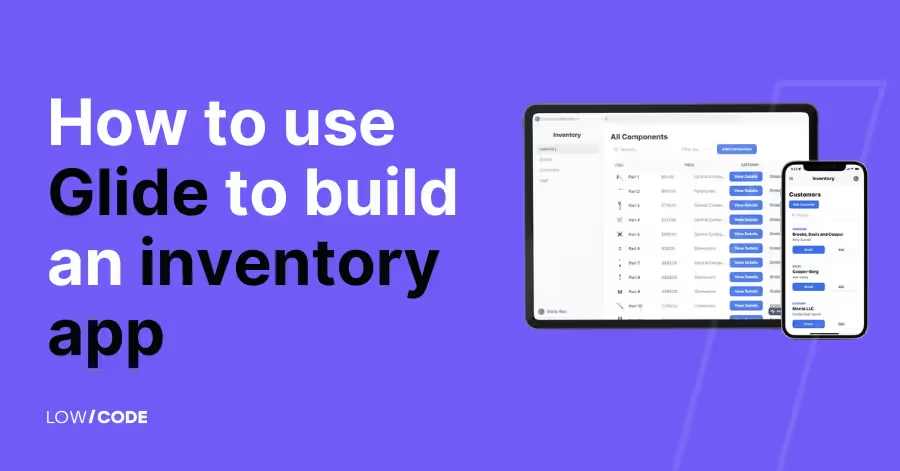
How to Build a Glide Inventory App (Step-by-Step Guide)
Build a Glide inventory app step by step. Learn setup, data structure, workflows, barcode scanning, user roles, and best practices to launch fast.

Glide
Comparison
Glide vs Retool | 10 Factors to Decide the Best One
Compare Glide vs Retool across 10 key factors to choose the right no-code tool for your internal apps, MVPs, or custom dashboards
Comparison
Glide
Glide vs Softr | 10 Factors Compared (2026)
Glide vs Softr compared across 10 key factors including ease of use, scalability, integrations, pricing, and flexibility. Discover which no-code platform fits your 2026 app goals.

Glide
What Is Glide? No-code App Builder Review
What is Glide? Learn how Glide works, its features, pricing, limits, and how to build powerful no-code apps from beginner to pro level.


Why customers trust us for no-code development


